Highlighting the grid
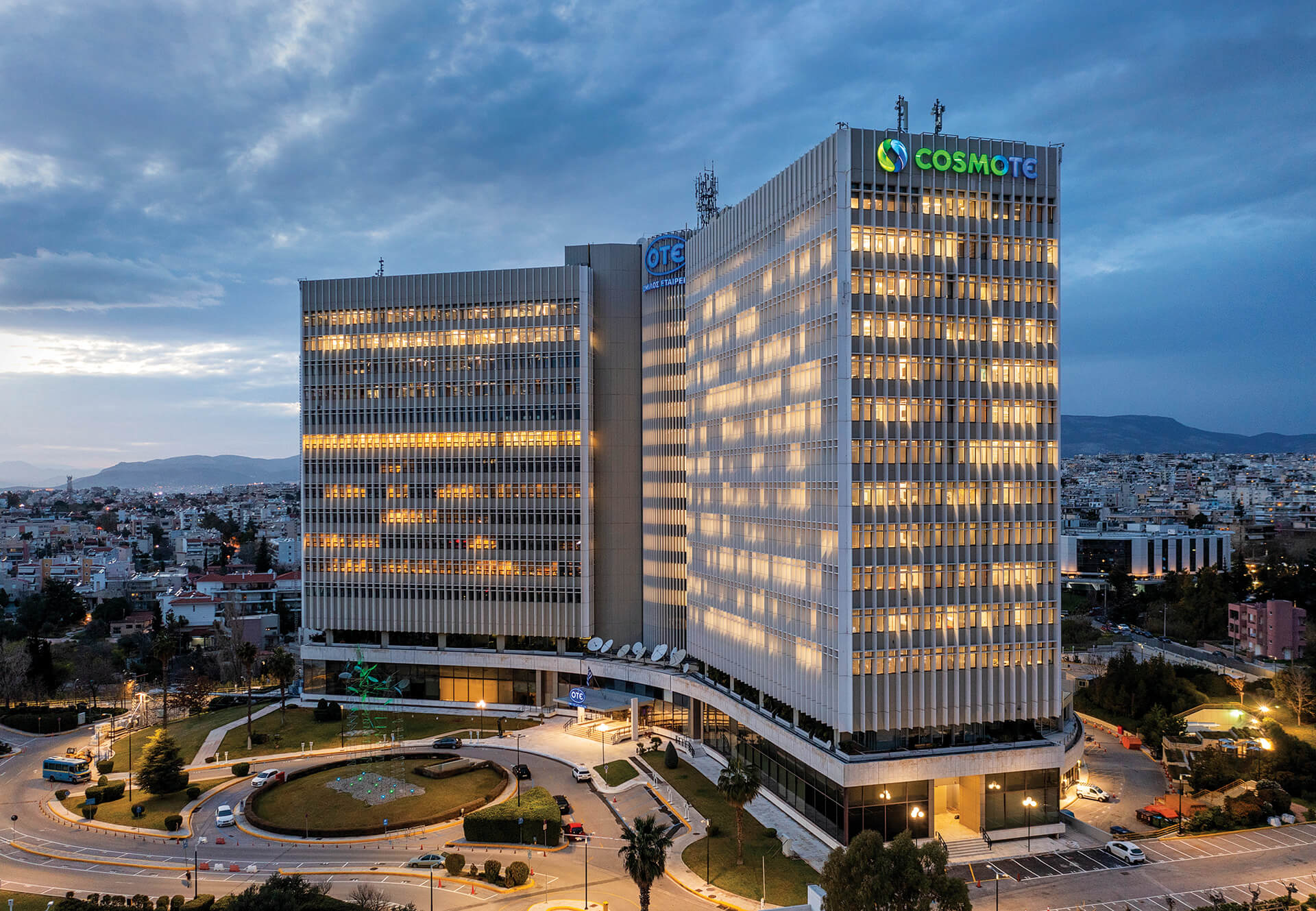
The OTE Headquarters in Athens is the realized architectural study of a multi-storey office building, star-shaped in plan, based on the proposal that was awarded second prize among twelve selected entries. The project concerns the renovation and reconstruction of office and communal spaces from the 2nd to the 13th floor; a decision made in 2019 within the framework of modernization and energy upgrading of the building envelope.
Building history and structure
The construction of the original volume began in 1974, with several modifications to the initial plans, while the building was ultimately put into operation in the 1980s, consolidating all services of the “Hellenic Telecommunications Organization.” On a plot of 52 stremmas, a building with a total floor area of 65,000m² was developed.
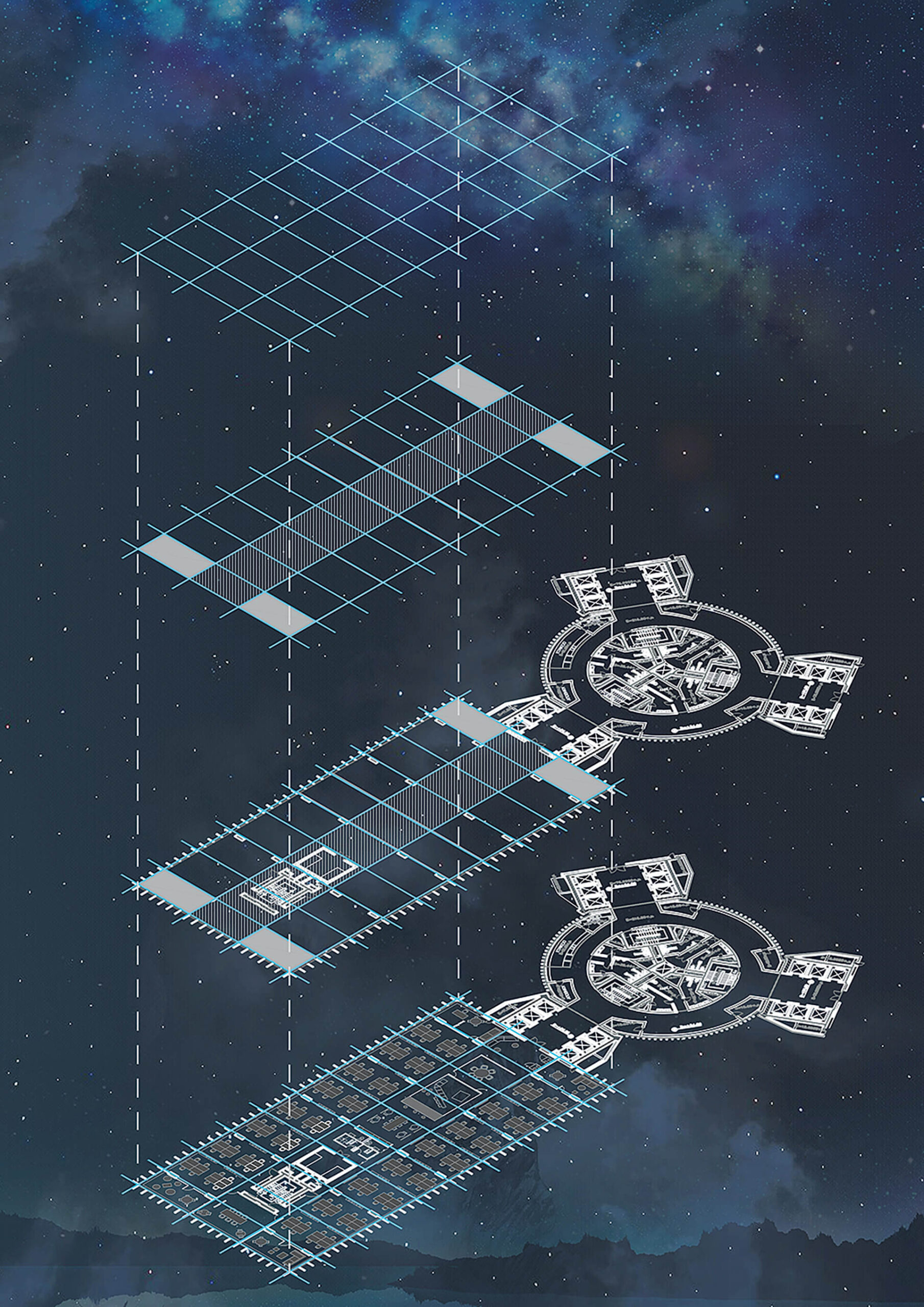
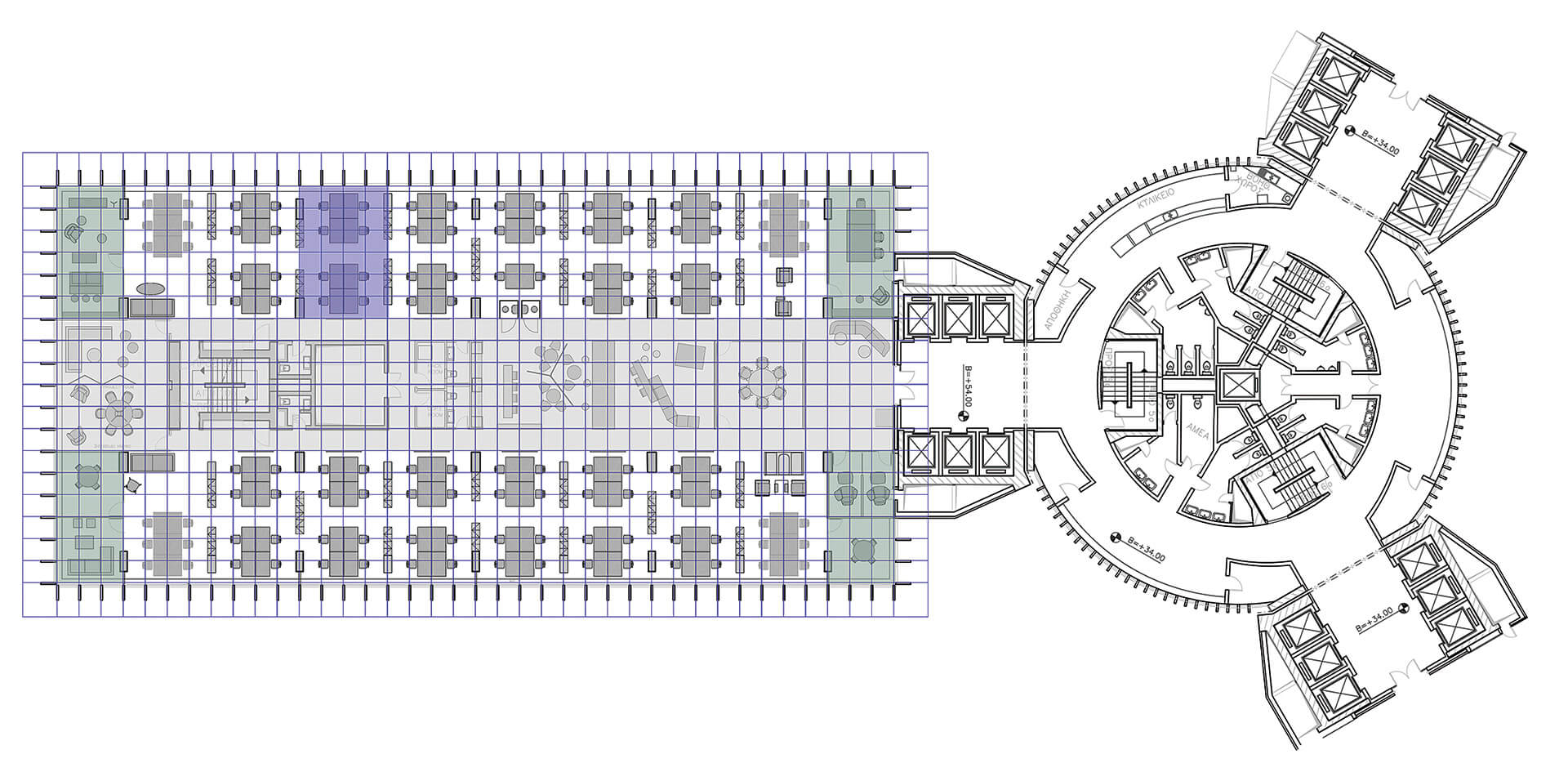
The new proposal for the interior layout of the office spaces followed the structural grid of the existing shell. The superstructure consists of three rectangular wings, connected through a central circular core of vertical circulation. Each of the 13-storey wings was designed on a vertical structural grid of 1.25×1.25 m, expressed on the façades through external, non-structural, horizontal and vertical reinforced concrete panels. A similar approach is applied to the circular core, where the panels are exclusively vertical and arranged in a radial configuration. Each wing was “divided” into three longitudinal zones, each corresponding to six openings of 1.25m, resulting in a total width of 7.50m per zone.
Functional organization
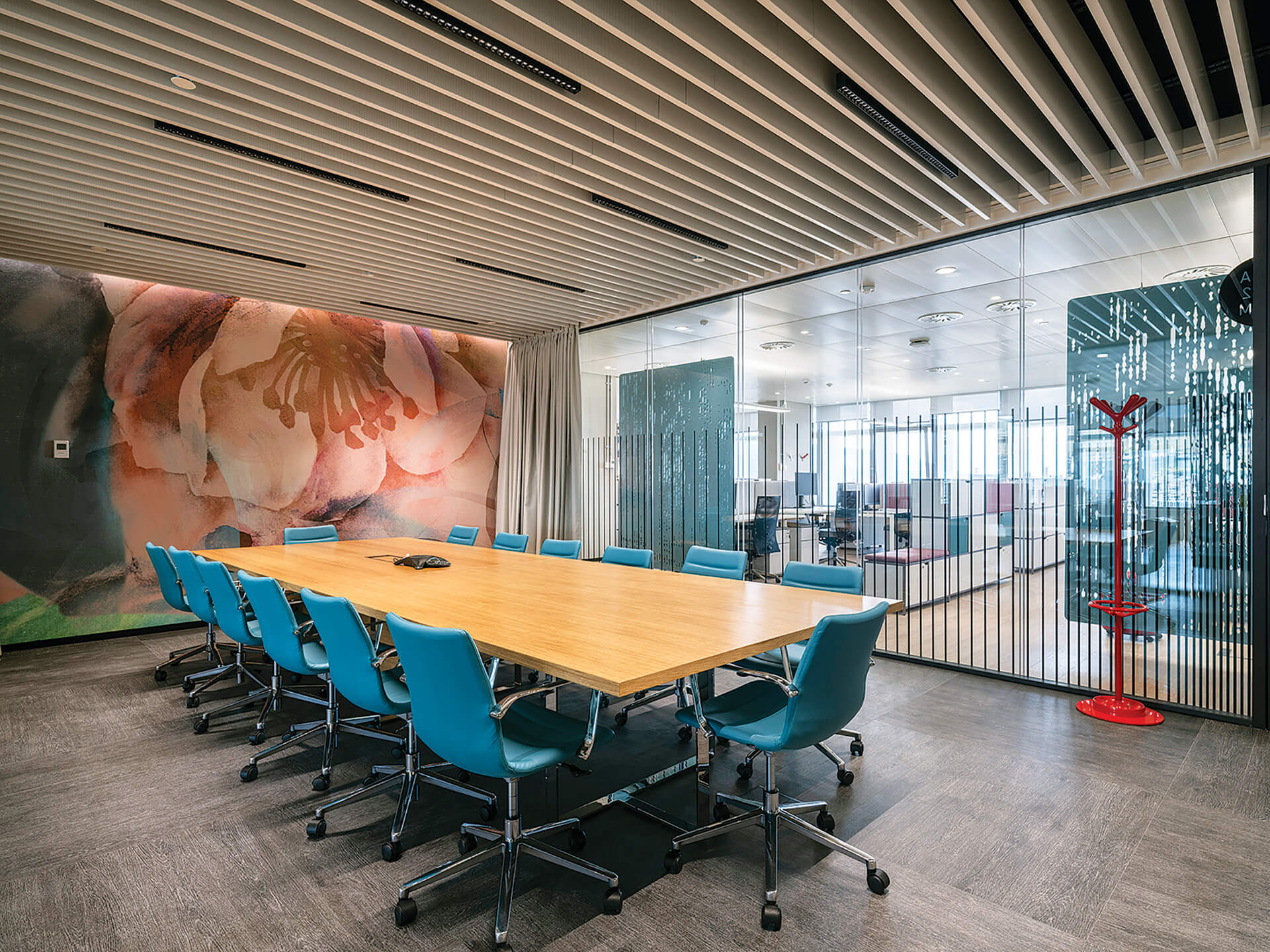
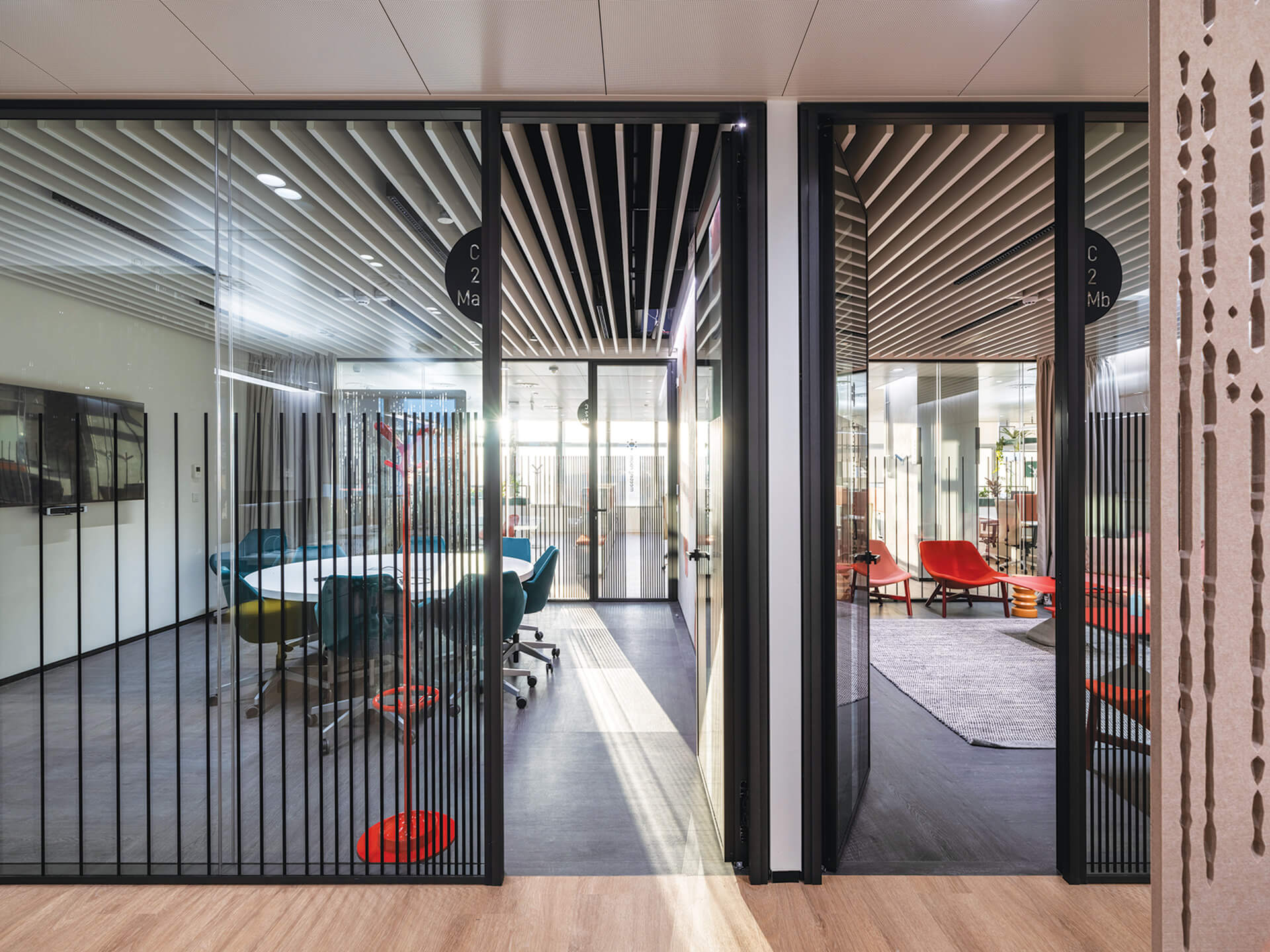
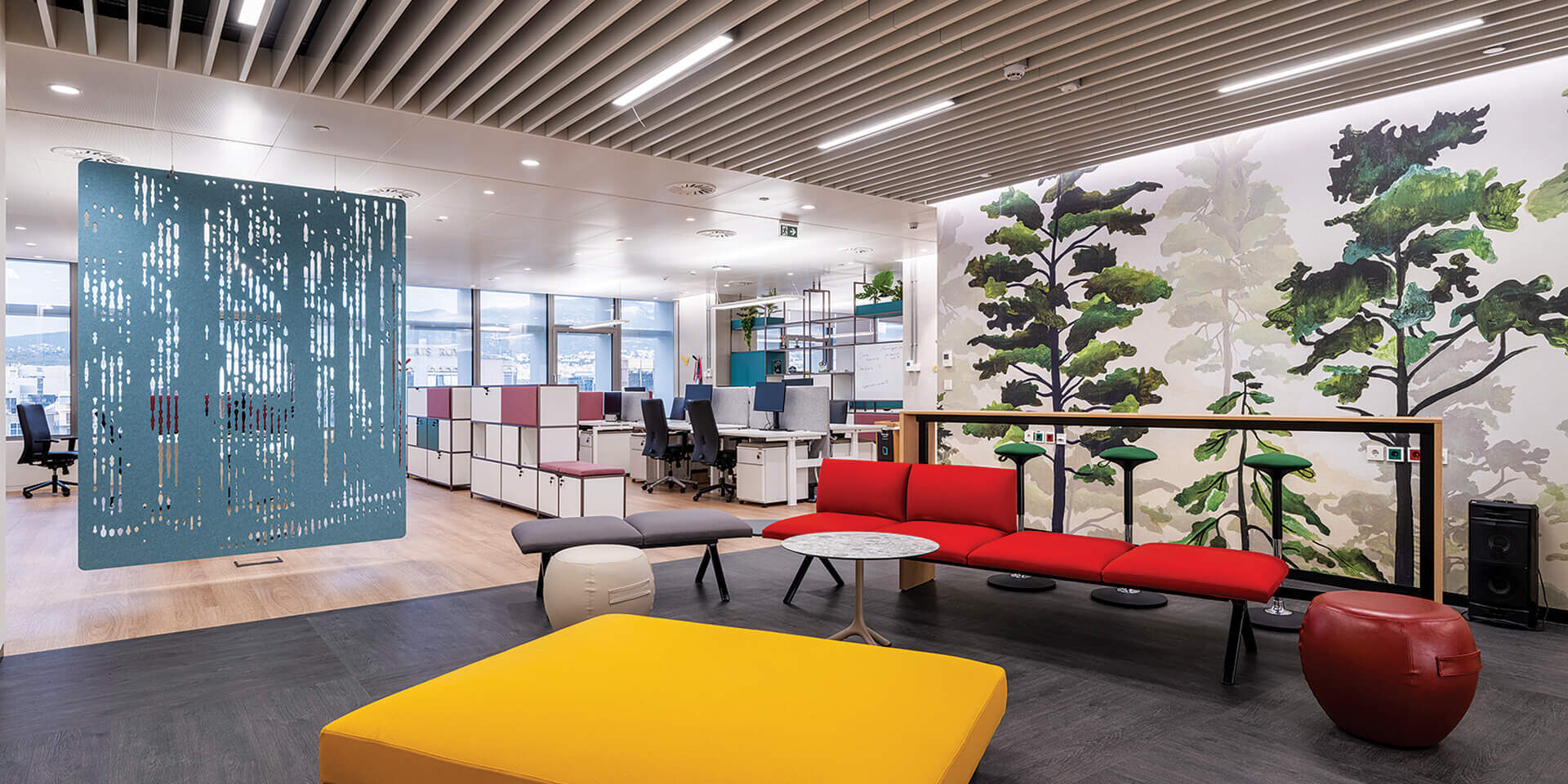
In this way, alternative work modules were developed in full correspondence with the building’s structural grid. In the two lateral zones of each wing, both open-plan and enclosed office spaces were arranged, along with dedicated meeting rooms. In these areas, which benefit from natural light and unobstructed views, the arrangement of workstations in two groups of four creates a maximum unit of eight workstations.
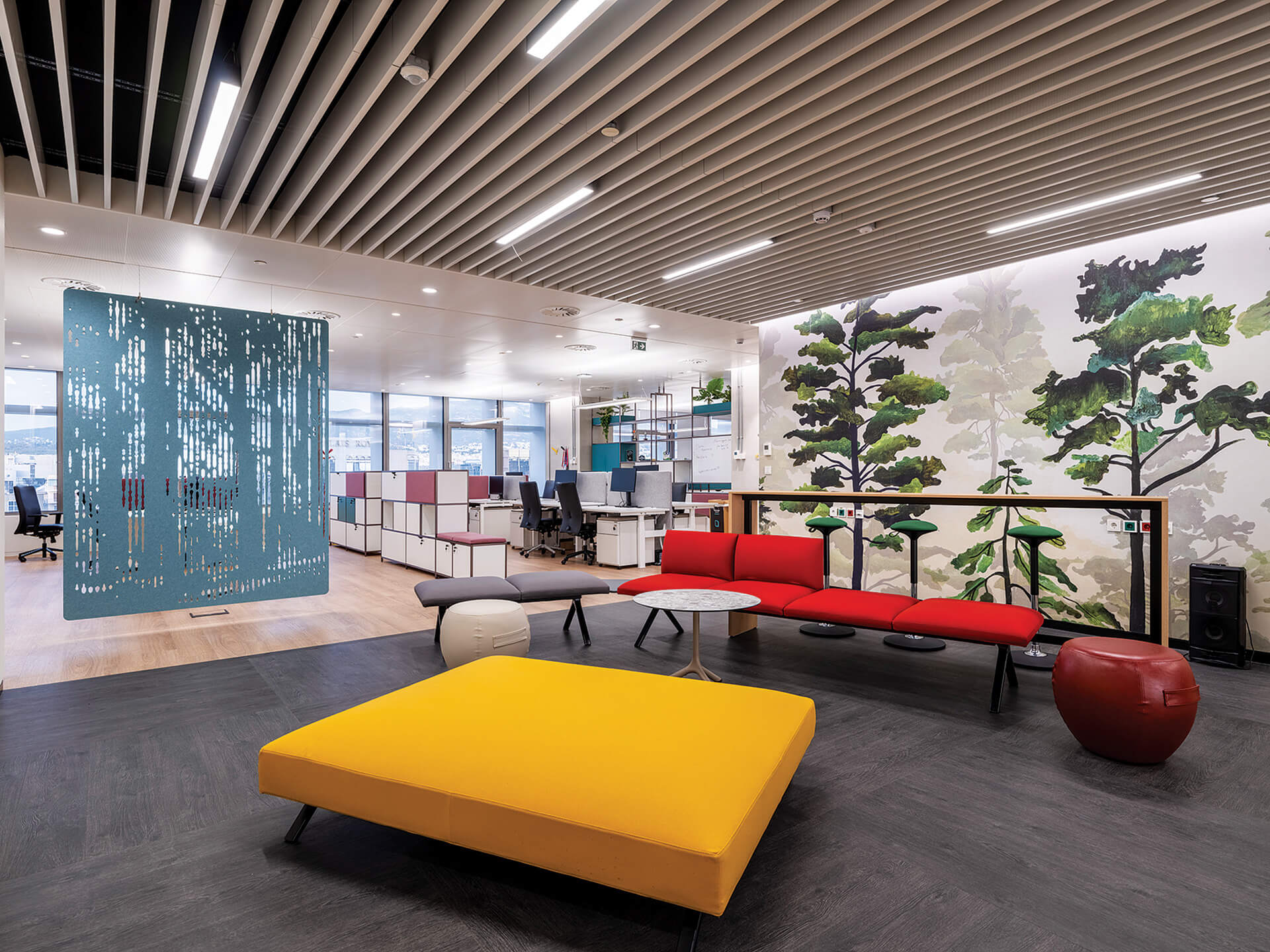
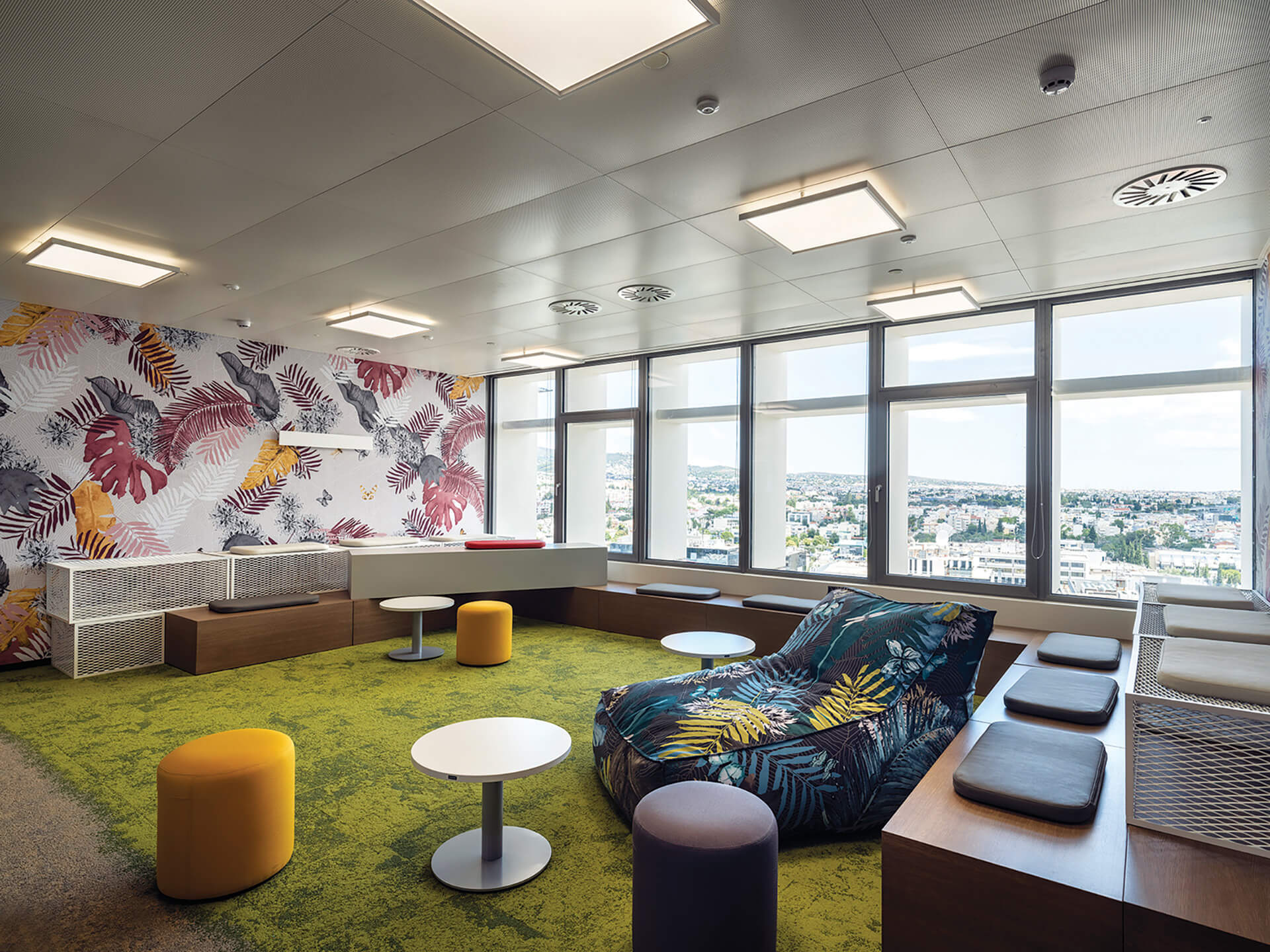
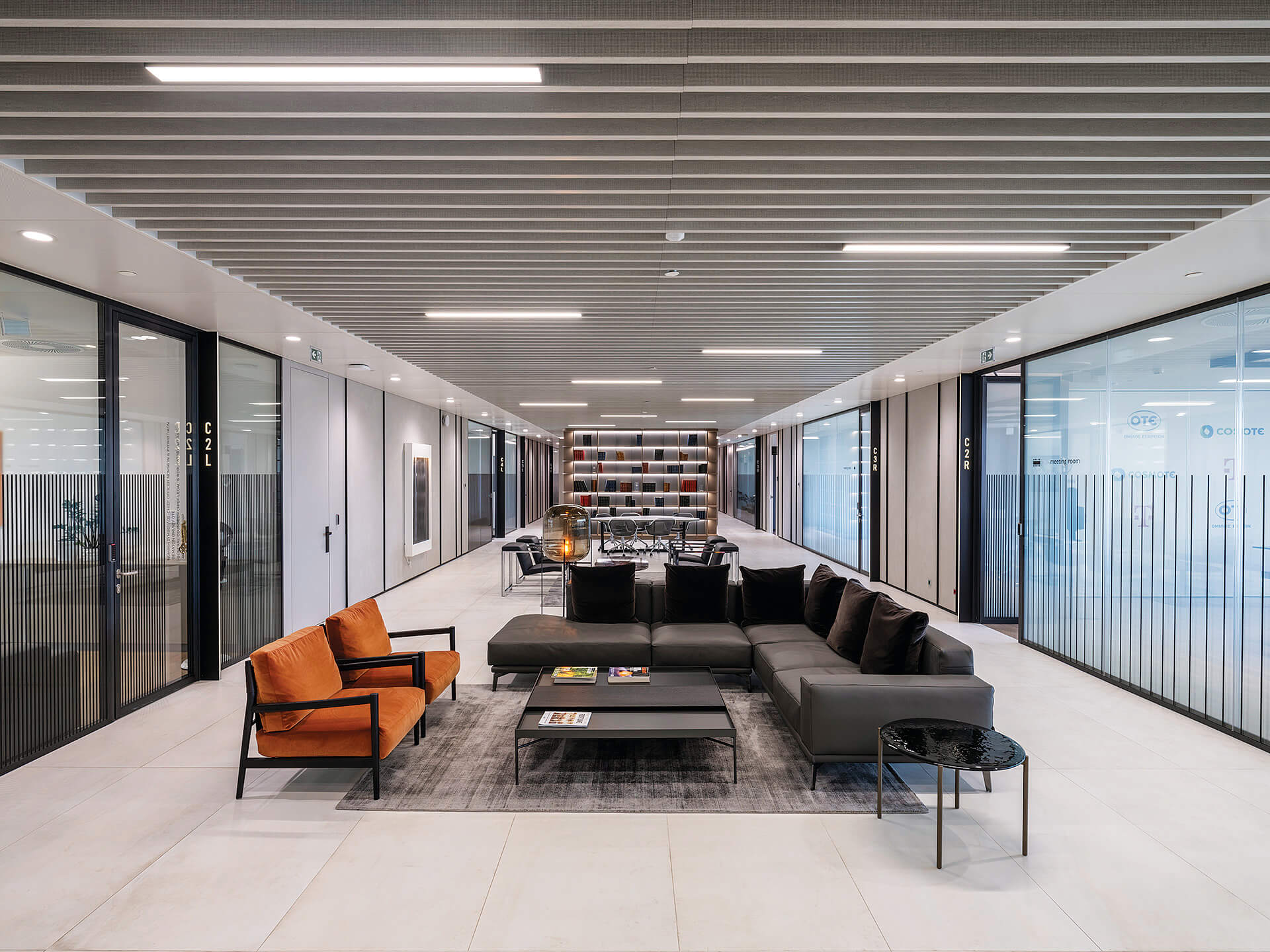
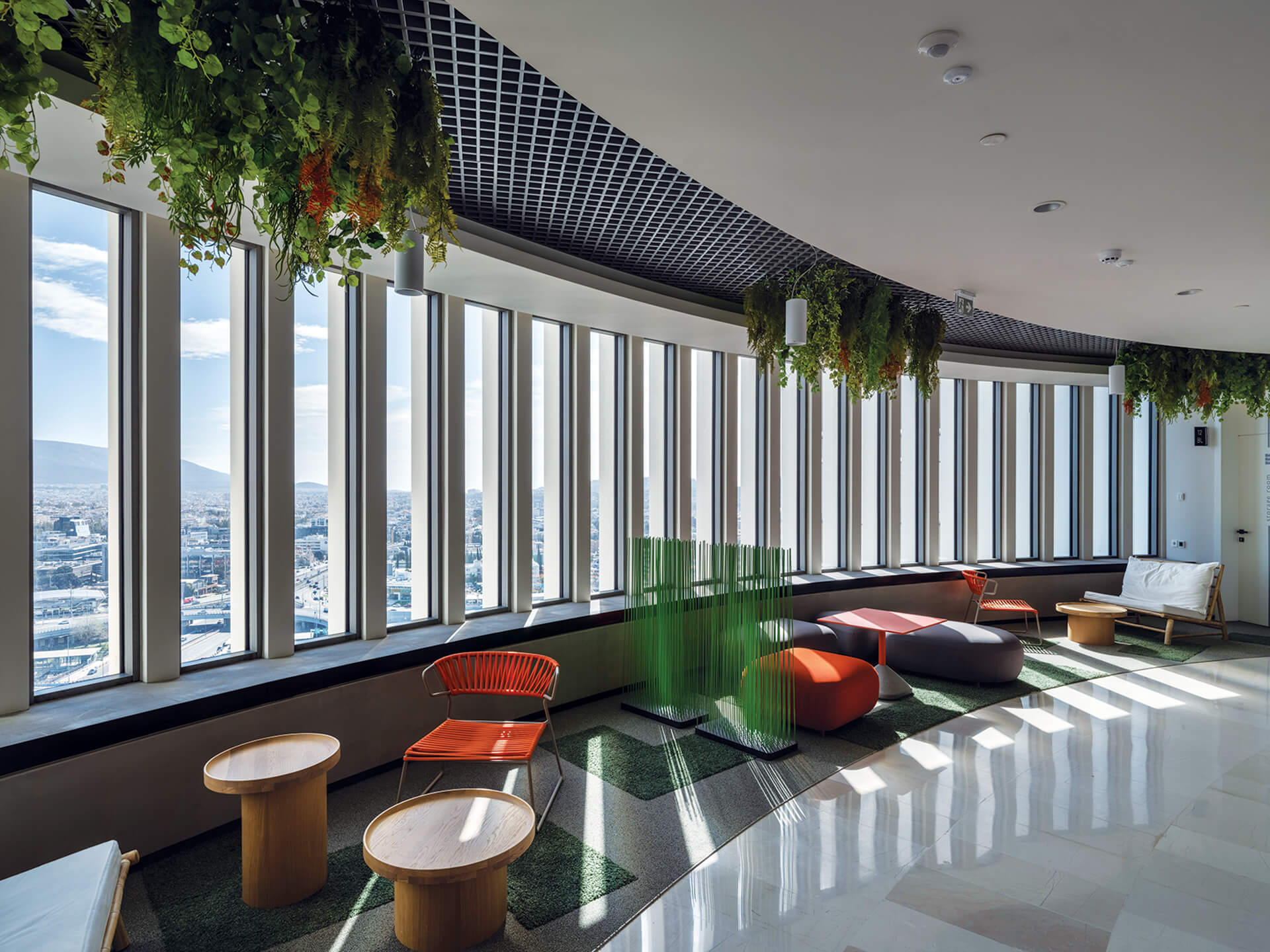
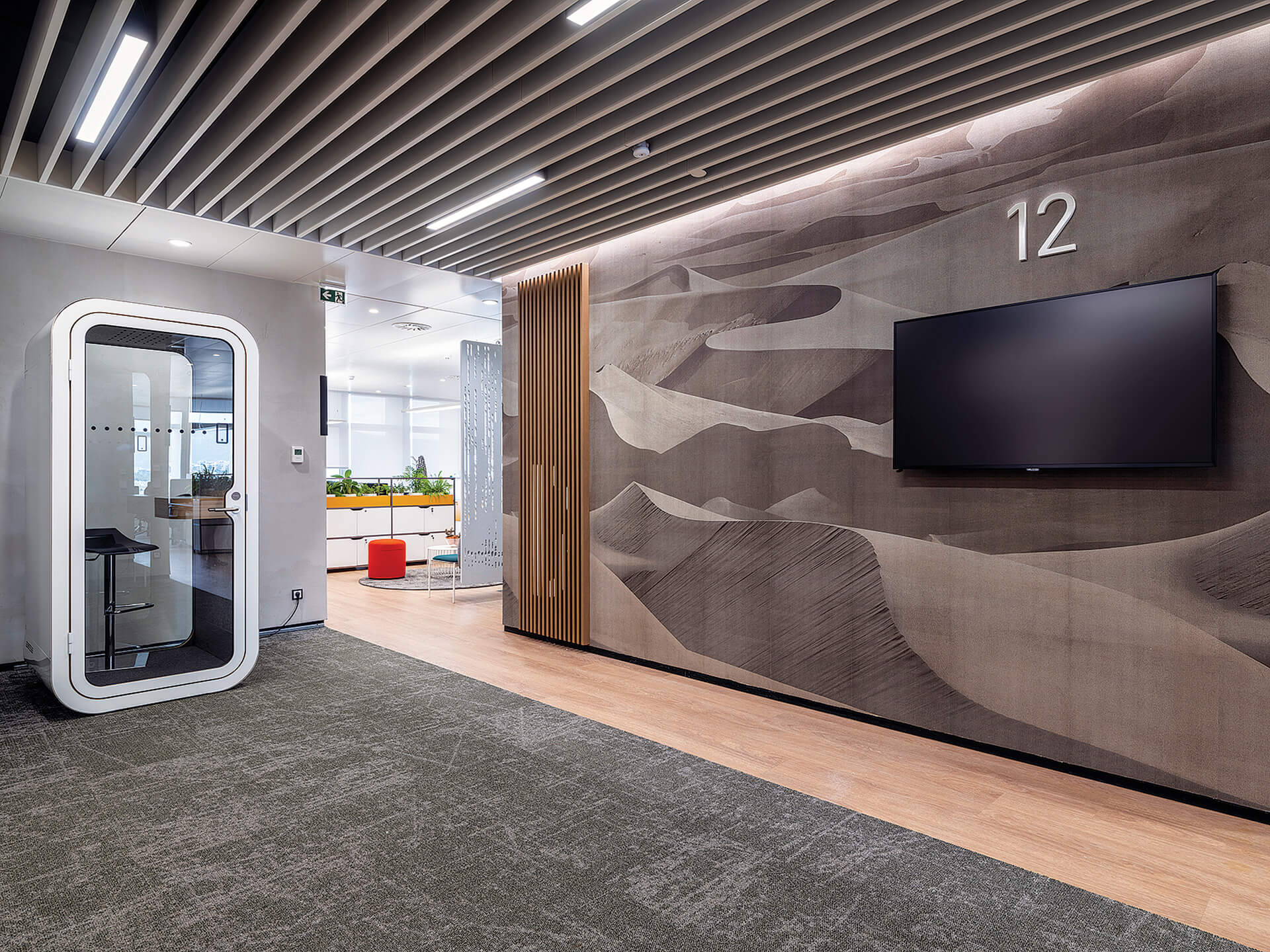
The four corner zones of each wing were enclosed with fixed partitions, accommodating special uses, alternating between executive offices, workspaces, collaboration areas, meeting rooms, relaxation zones, creative spaces, rest areas, and spaces for employee retreat.
Movable, flexible, or fixed partitions for integration, repetition, or separation can accommodate – with mechanical precision – all possible conditions of flexibility, functionality, and adaptability. In the central zone, aligned with the structural grid, meeting rooms, sanitary facilities, and support spaces are developed.
Design Interventions
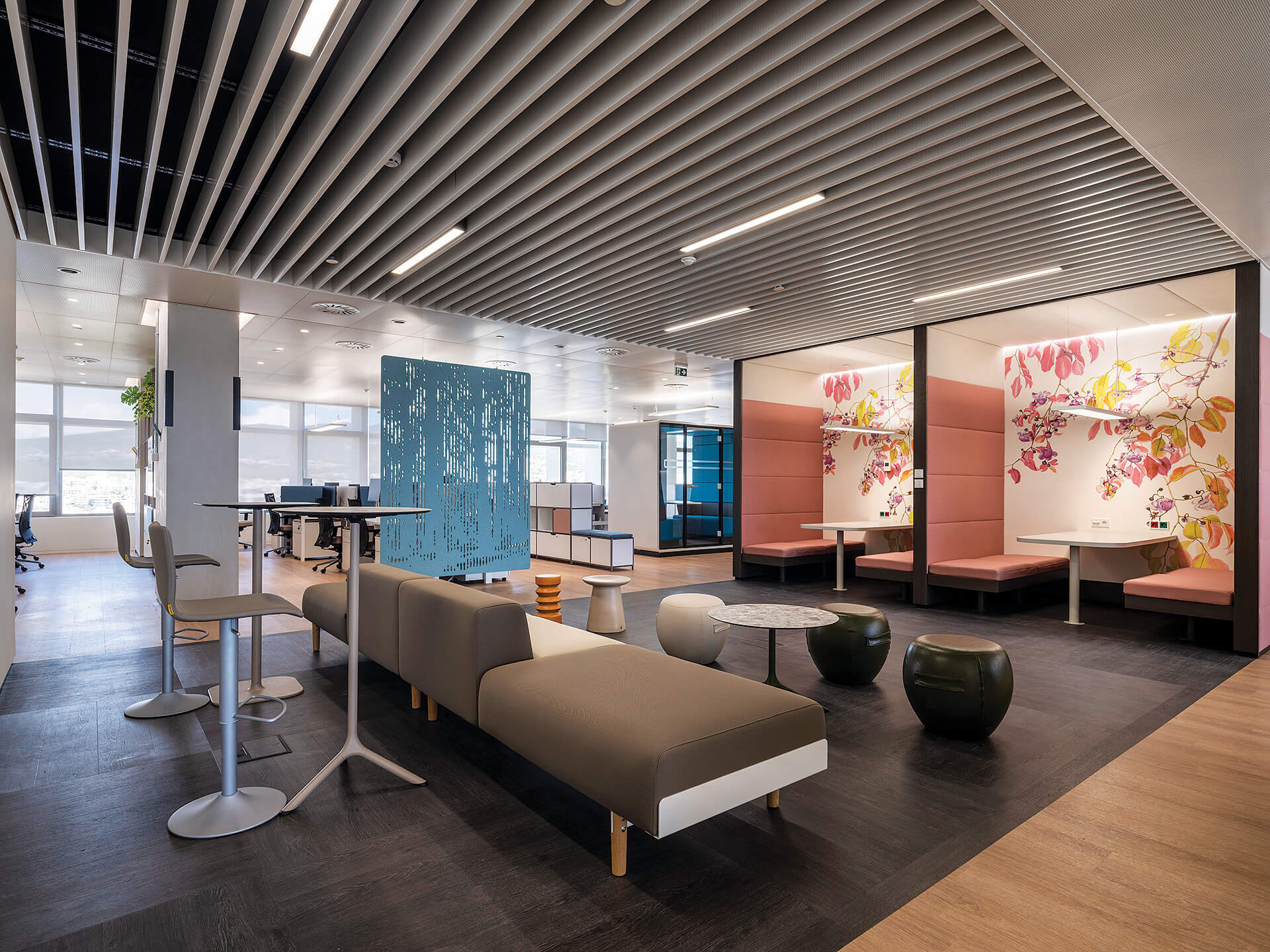
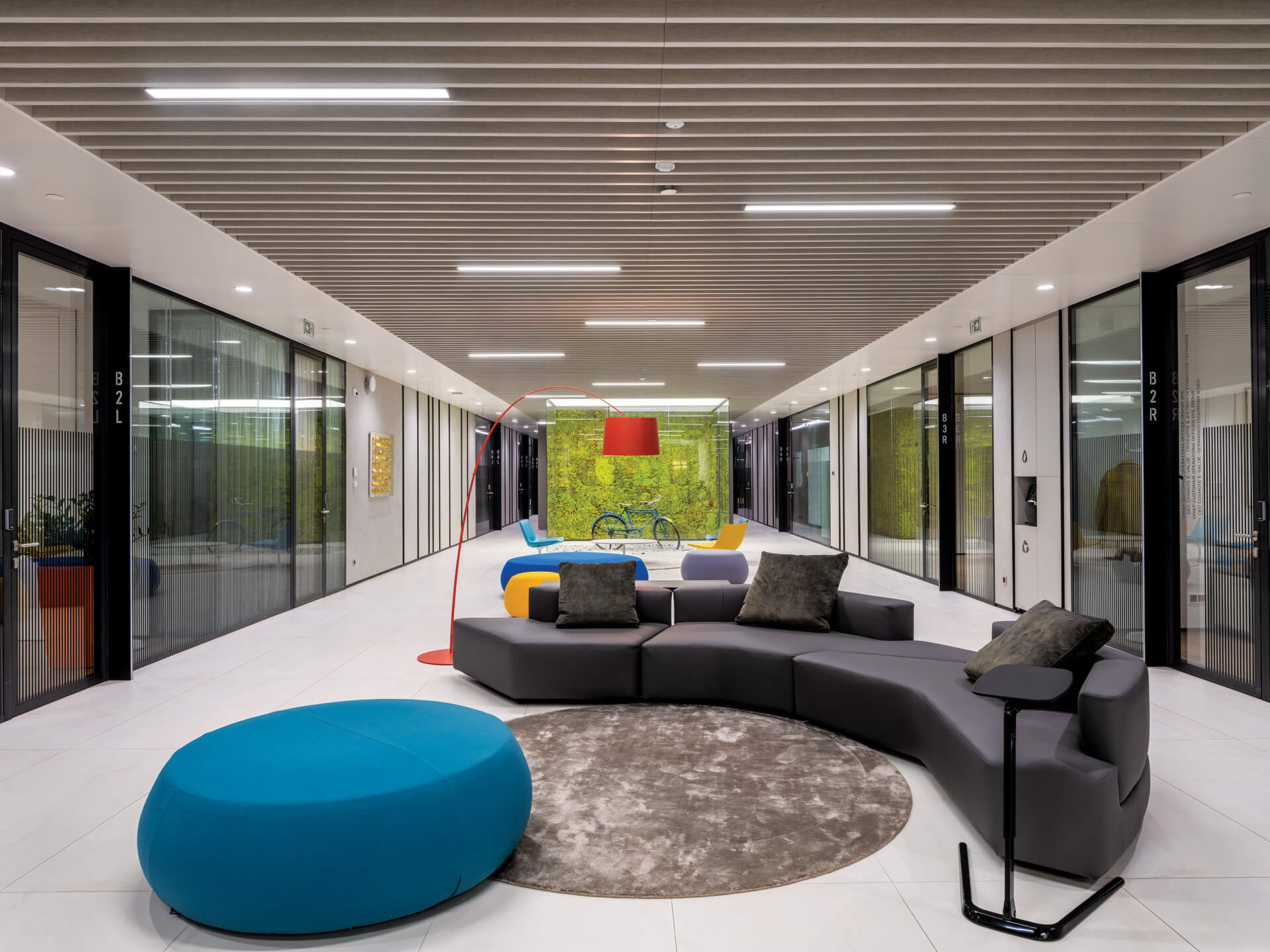
These include meeting rooms and areas, WCs, a closed kitchen, printing and copying rooms, semi-open meeting booths for private discussions, and open communal spaces for gathering and relaxation. A significant portion is occupied by the existing central core, which houses MEP spaces and the emergency staircase, while a dedicated project/meeting room at the top level, along with the distinctive design and material selection of the entrance area, complete the central zone.
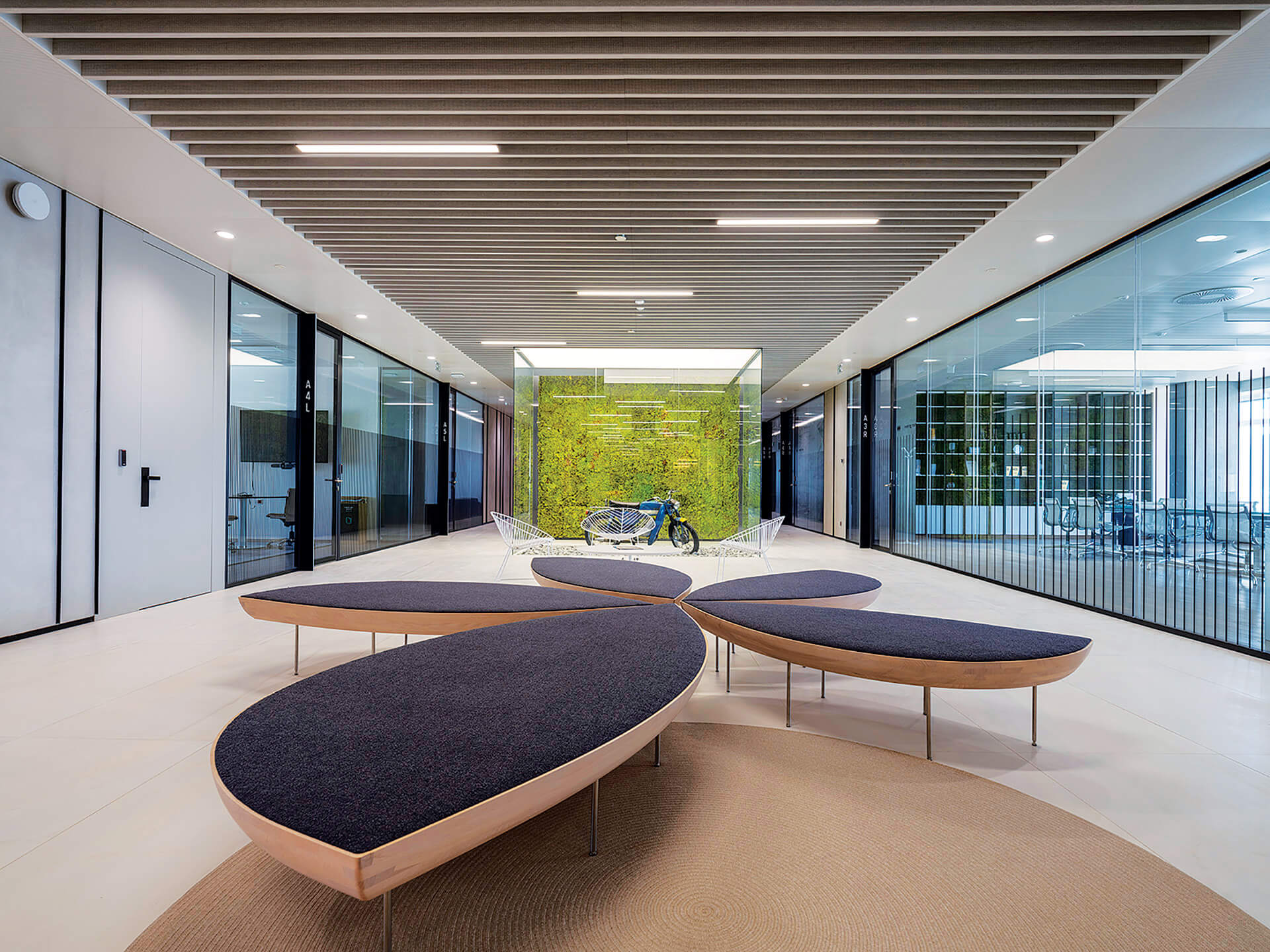
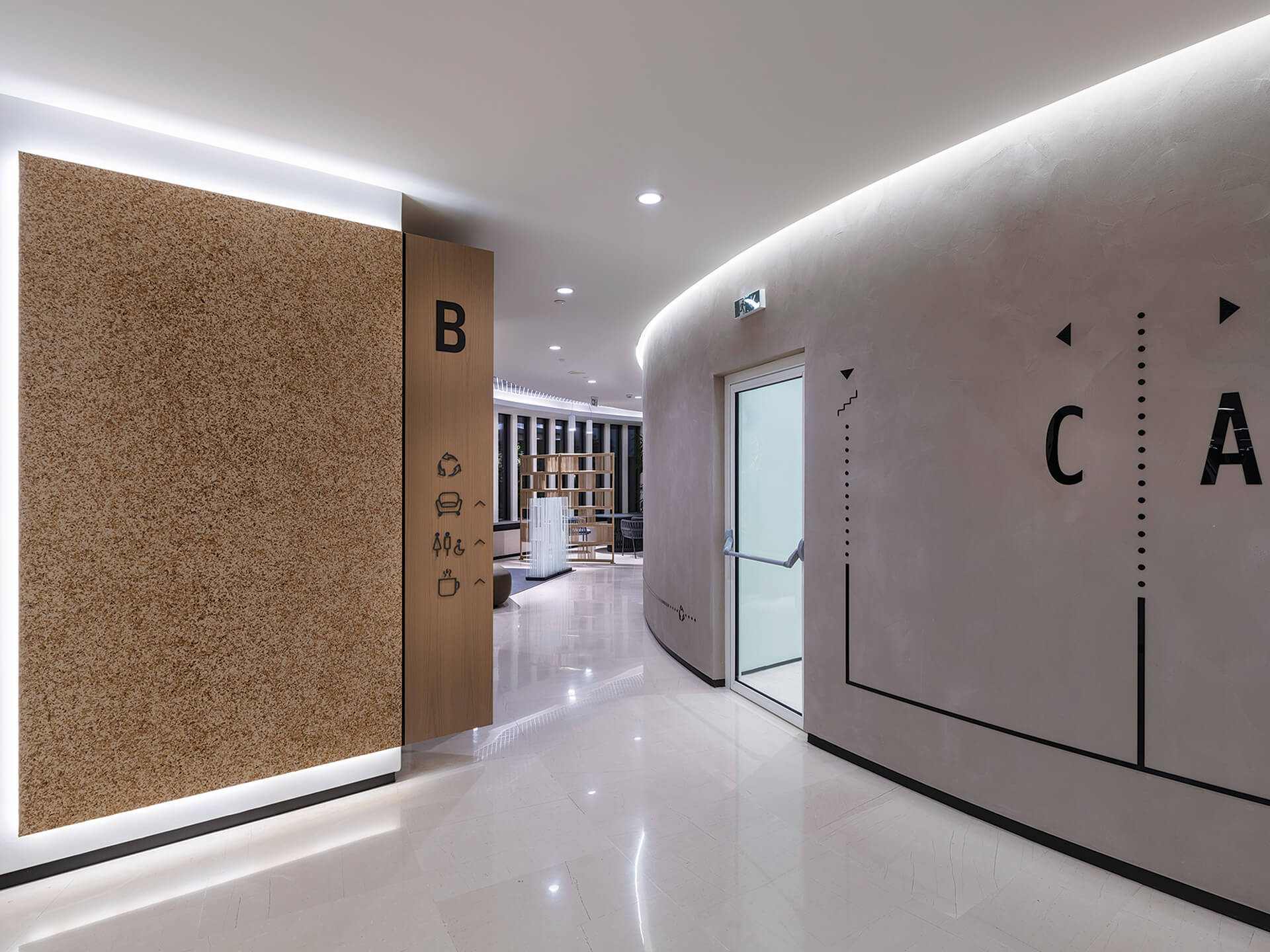
The primary function of the central circular core is circulation and communication, and secondarily, it accommodates auxiliary uses such as WCs and storage areas. Interventions were kept to a minimum, focusing on the refinement of existing material finishes or the localized addition of new ones, the redesign of lighting and ceilings, and the introduction of custom constructions and selected furniture pieces in the radial, curved areas for rest or breaks between the wings.
In one of these areas, the open food service space (cafeteria) was fully upgraded according to specifications, with new elements, lighting, and equipment. Similarly, the WCs were upgraded through the replacement of partitions, claddings, and sanitary fixtures.
Material Palette
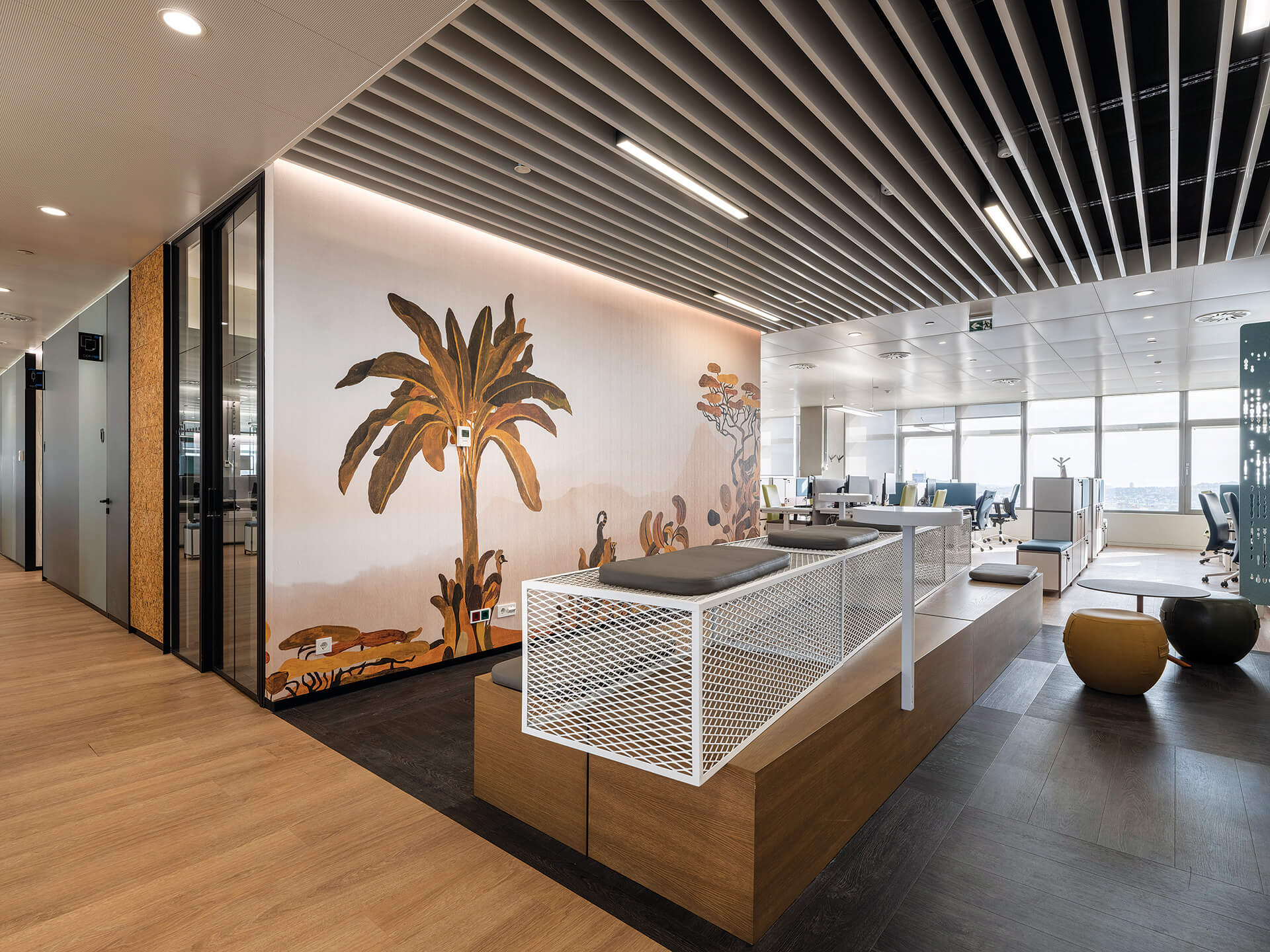
Key parameters in the process of design, selection, and application methods of materials were compliance with the requirements of LEED and WELL Building Standard certification systems.
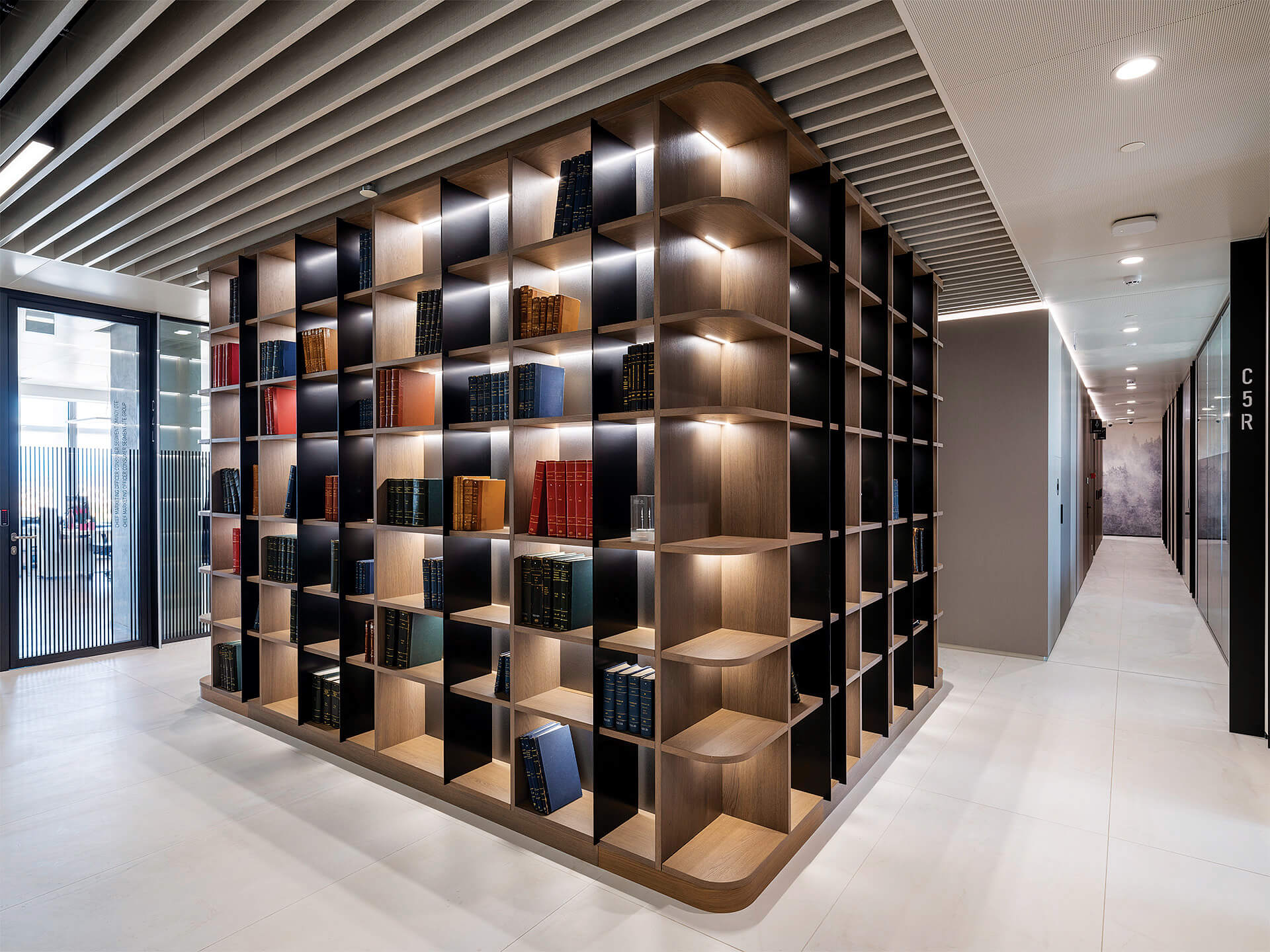
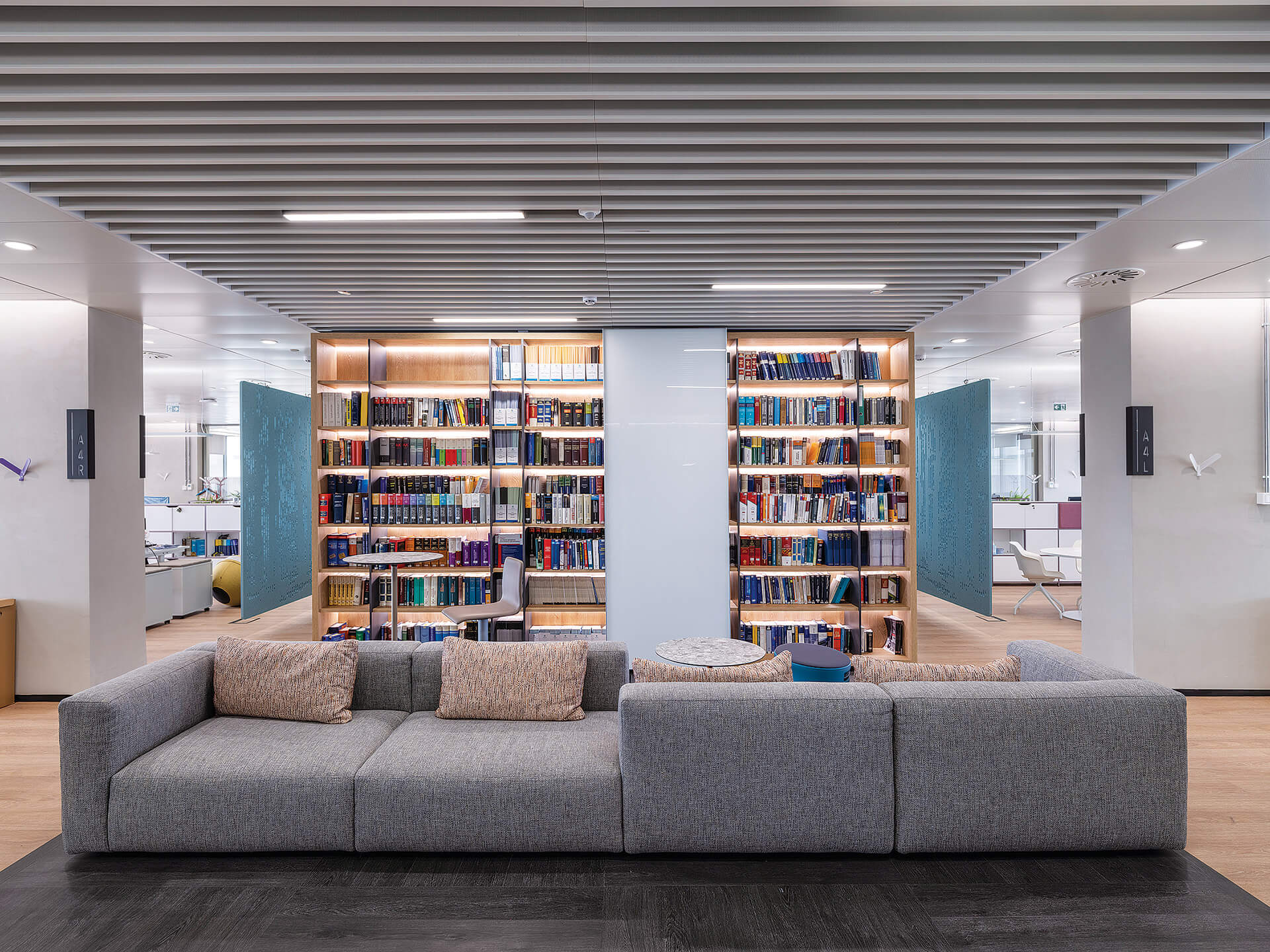
The construction materials follow the logic of a central design strategy, with consistent choices in flooring, acoustic ceilings, and lighting, combined with numerous variations in claddings, textures, colors, subtle tonalities, material qualities, and furniture equipment. In this way, each wing and floor forms a distinct yet unique visual identity, resulting in a cohesive compositional and aesthetic outcome aligned with the new concept of the study.
The architectural design of the new interior layouts of the headquarters, along with its subtle visual differentiation on the façade (through the replacement of aluminum frames), completes its aesthetic identity, fully implementing the requirements of certification systems, while respecting the existing shell and reinforcing the building’s established presence in the urban consciousness of a major organization.
https://ek-mag.com/wp-content/uploads/2026/03/00-cover-22.jpg
https://ek-mag.com/wp-content/uploads/2026/03/01-24.jpg
https://ek-mag.com/wp-content/uploads/2026/03/02-24.jpg
https://ek-mag.com/wp-content/uploads/2026/03/03-24.jpg
https://ek-mag.com/wp-content/uploads/2026/03/04-24.jpg
https://ek-mag.com/wp-content/uploads/2026/03/05-25.jpg
https://ek-mag.com/wp-content/uploads/2026/03/06-23.jpg
https://ek-mag.com/wp-content/uploads/2026/03/07-23.jpg
https://ek-mag.com/wp-content/uploads/2026/03/08-22.jpg
https://ek-mag.com/wp-content/uploads/2026/03/09-19.jpg
https://ek-mag.com/wp-content/uploads/2026/03/10-18.jpg
https://ek-mag.com/wp-content/uploads/2026/03/11-13.jpg
https://ek-mag.com/wp-content/uploads/2026/03/12-13.jpg
https://ek-mag.com/wp-content/uploads/2026/03/13-12.jpg
https://ek-mag.com/wp-content/uploads/2026/03/14-10.jpg
https://ek-mag.com/wp-content/uploads/2026/03/15-8.jpg
https://ek-mag.com/wp-content/uploads/2026/03/16-6-scaled.jpg
Related Posts